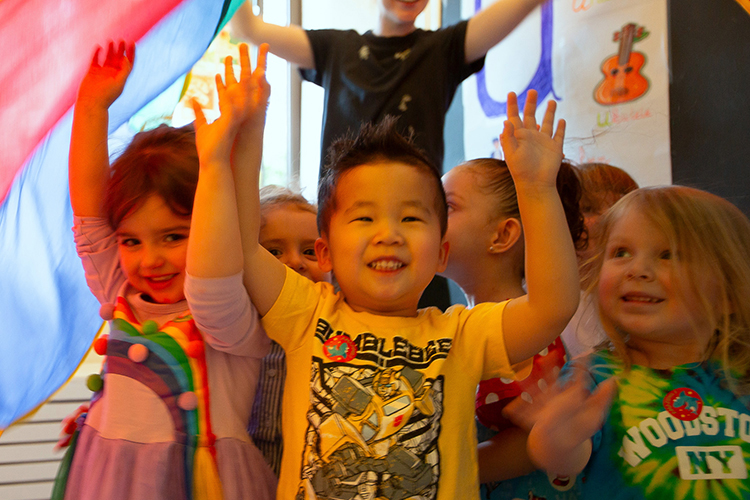
When you walk into our rooms at La Maternelle with locations on the Upper West Side (UWS) and midtown Manhattan, you see blocks, songs, and small hands at work, and none of that is idle time. Play is the heart of preschool childcare at our French-English daycare program and one of the ways that your children find purpose.
How Purpose Takes Shape in Preschool Childcare
An adult might look at a child’s tower of wooden cubes rising and falling and think only of the noise. But the child who plays with them is actually practicing planning, focus, and flexibility: the same capacities that later help a person wait their turn, follow a plan, and change course when a plan fails. These are the capacities we need for good self-regulation.
That’s why play should be a learning method, not an intermission to learning. Play promotes joyful learning and nurtures self-regulation, language, cognition, social competence, and knowledge. A child who sets a table of acorns for three dolls is also rehearsing numbers and the social script of being a host. A child who argues, gently, over who will be the baker learns how speech can settle a dispute. You will hear French and English in the same circle at our preschool because language, for us, lives inside the game rather than apart from it.
Guidance to a Goal
Free play leaves the child in charge of the ideas, while direct instruction leaves the adult in charge of the script. Guided play keeps the child’s initiative while also giving adults the ability to arrange the materials, ask a question that thickens the problem, name a word the child is reaching for, and otherwise guide the play to a more structured and purposeful end.
A 2022 systematic review of studies on play published in Child Development found that guided play produced stronger gains than direct instruction on mathematics learning, shape knowledge, and task switching as well as stronger spatial vocabulary than unguided free play.
Routines: From Small to Great
Purpose appears first in the very small acts, such as when a two-year-old carries a cup to the sink. That child has begun the long work of learning, “I can do this myself.” A three-year-old who hangs up a coat, then helps a friend with a zipper, has moved from self-care into care for another. Those routines are actually part of the curriculum: dressing, tidying, managing one’s belongings, and, when a child is ready, toilet learning, are not chores added in after the lesson. They are lessons!
Bilingual Language Use
Songs, stories, and conversation in French and English give children two codes for the same world. Children who must hold two languages in their minds are constantly practicing inhibition and switching as a matter of daily speech, and that cognitive advantage makes a big difference. They are learning cognitive flexibility, but because they’re learning it naturally, as part of play, it builds naturally and effortlessly.
Come see how play has a purpose. Schedule a tour with La Maternelle today at one of our locations here in New York City including the Upper West Side and midtown/Hell’s Kitchen and walk the rooms where your child’s play is for a purpose. Offering programs for infants, toddlers and children from 3 months to 5 years old.